Communication Products
Optical Transceivers · Telecom Synchronization · Network Infrastructure · Custom Solutions
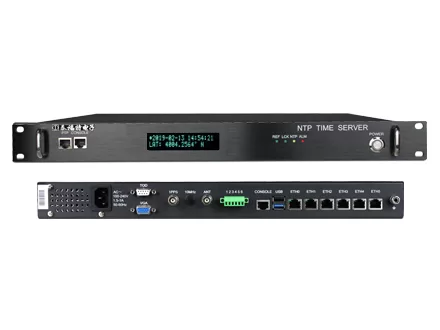
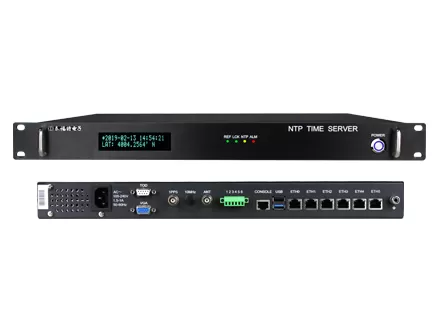
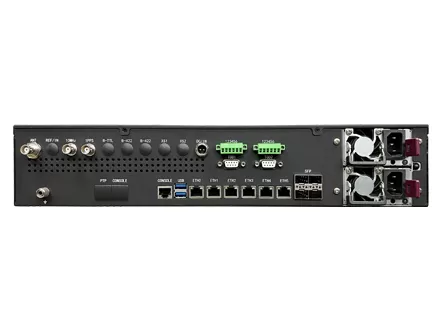
The APEX APX-TS200-GN is a GNSS network time server: it locks to a satellite reference, then serves that time to every device on the IP network through NTP and SNTP, with physical timing outputs for equipment that does not speak packet time at all.
The reason a network needs one is traceability. Servers, controllers, protection relays and log systems all stamp events, and those stamps only correlate if they come from one authoritative source. The APX-TS200-GN provides that source from GPS and BeiDou, so time in the building, the plant or the central office is aligned to a global reference rather than to each device's own clock.
It is used in carrier and metro sites, data centres, power and utility substations, transport infrastructure and industrial networks. The unit is a 1U rack mount chassis with a web interface for configuration and monitoring, and it can hold time locally if the satellite signal is briefly interrupted.
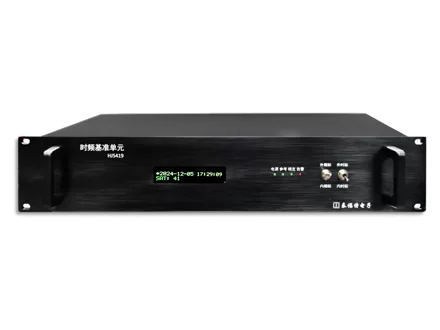
The GNSS family has three members: the standard APX-TS200-GN, the APX-TS200-GN-O with an OCXO holdover oscillator, and the APX-TS200-GN-R with a rubidium oscillator. Which one fits depends on how long the site must stay accurate after the antenna is lost, not on the network size.
| Specification | Detail |
|---|---|
| Part Number | APX-TS200-GN |
| Product Type | GNSS network time server (NTP / SNTP) |
| GNSS Reference | GPS, BeiDou, GPS + BeiDou |
| Satellite Timing Accuracy | Better than 30 ns RMS (1PPS, hardware timestamped) |
| Network Protocol | NTP v1/v2/v3/v4, SNTP |
| NTP Accuracy | Typically 0.1 to 2 ms inside the local network |
| Network Interfaces | Up to 6 x Gigabit Ethernet |
| Timing Outputs | 1PPS, 10MHz, IRIG-B, TOD, PTP (option) |
| Reference Inputs | 1PPS + TOD, IRIG-B, PTP, external frequency reference (option) |
| Time Server Throughput | Sized for large client counts across the site |
| Holdover | Standard oscillator; OCXO and rubidium available in the same family |
| Redundancy | Redundant power supply option, reference priority with automatic switching |
| Management | Web interface, SNMP, SYSLOG, email, dry contact alarms |
| Platform | Embedded Linux, optional monitoring software |
| Mounting | 1U 19 inch rack mount |
| Compliance | CE, RoHS |
Family members are listed below as plain text so they can be copied into an RFQ or a spreadsheet.
| Model | Reference | Oscillator | Fits |
|---|---|---|---|
| APX-TS200-GN | GPS, BeiDou, BeiDou-3 | Standard | Sites with a clear antenna view and short outages |
| APX-TS200-GN-O | GPS, BeiDou | OCXO | Sites that lose the satellite for minutes at a time |
| APX-TS200-GN-R | GPS, BeiDou | Rubidium | Sites that must hold time for hours after an outage |
Give transport, transmission and service platforms one traceable time reference per site, with NTP for the management network and 1PPS or 10MHz for the racks that still expect a physical signal.
Align event records, RTUs and protection devices to a common reference so the sequence of an incident can be reconstructed from logs taken across the substation.
Serve time to server fleets, storage, CCTV, fare and ticketing systems, plant controllers and building systems that stamp events and must agree with each other.
Three things decide the model and the layout: the antenna view, the holdover the site needs, and whether the equipment speaks NTP. The antenna is the part that most often goes wrong, so the survey comes first: a clear view of the sky, a short low loss cable run, and surge protection at the entry point. The GNSS antennas and accessories range covers the antenna, the cable, the splitter and the protector as one set.
Holdover decides the oscillator. If the antenna is on the roof of the same building and outages are short, the standard APX-TS200-GN is enough, because the unit holds the last known good time across a brief interruption. If the site sits on a mountain top, shares the roof with other tenants, or has a history of cable damage, choose the OCXO or rubidium member of the family so the NTP and 1PPS outputs stay inside their limits while the sky is blocked.
On the network side, keep the timing service on its own interface where you can. One port to the management network, one to the service network, and the remaining ports for equipment that must poll the server directly. Where more than one server is deployed, the reference priority and automatic switching settings decide which unit answers, and the monitoring tools will report client counts and per-reference statistics so you can see it working.
For a topology view of the whole line, start from the GNSS / NTP network time servers range, then move to the PTP grandmaster clocks if part of the network needs phase as well as frequency.
The APX-TS200-GN serves any device that speaks NTP or SNTP, including servers, switches, routers, firewalls, cameras, controllers and building systems, and it feeds non-packet equipment from the 1PPS, 10MHz, IRIG-B and TOD outputs. Tell us the devices that must be synchronised, the number of clients you expect, and whether a second server has to protect the site, and we confirm which member of the family to quote.
They use the same GNSS receiver and the same NTP and timing interface set. The difference is the oscillator that carries the site through a satellite outage: standard, OCXO or rubidium.
GPS alone is enough in most regions, BeiDou where the local constellation gives better geometry, and combined GPS + BeiDou where the antenna view is partly blocked and you want the receiver to work with more satellites.
The platform is sized for large client counts, but the practical limit is the network and the polling interval rather than a fixed number. Send the client count and poll interval and we confirm the interface plan.
Yes. It holds the last known good time and returns to the satellite reference automatically. How long it stays inside your accuracy budget during that outage is what the OCXO and rubidium versions extend.
Yes. The 1PPS, 10MHz, IRIG-B and TOD outputs are provided for equipment that needs a physical time or frequency reference.

APEX is a communication technology brand focused on optical transceivers, telecom synchronization products, and network infrastructure equipment. We provide products and engineering support for telecom operators, data centers, mobile networks, and enterprise customers worldwide.
APEX GROUP is headquartered in Hong Kong, with our core team and supply chain operations based in China. We ship to customers across Asia, the Middle East, Europe, Africa, and the Americas.
We are a brand owner with deep engineering partnerships. We control product design, specification, quality validation, and supply chain management. Our products are built to our specifications by qualified manufacturing partners, and we handle all testing, coding, and quality assurance before shipment.
Yes. We code transceivers to match the host platform requirements of major switch and router vendors including Cisco, Juniper, Arista, HPE, Huawei, Nokia, and others. Tell us your platform model and required OS version, and we will ship modules that are recognized natively by your equipment.
Datasheets, compatibility matrices, and S-parameter reports are available for all standard products. Contact our sales team or visit the product pages on our website to request documentation.
Provide us with your switch make, model, and OS version. We code the transceiver firmware accordingly before shipment. If you are testing for the first time, we recommend ordering a sample unit to validate compatibility in your specific environment before placing a volume order.
Switch vendors occasionally introduce transceiver whitelisting in new OS releases. We track major platform updates and can provide recoded firmware matching the new OS requirements. Contact technical support if your existing APEX modules stop being recognized after a switch upgrade.
Contact our sales team by email, WhatsApp, or WeChat with your part number and quantity. We will confirm pricing, lead time, and shipping options. For first-time customers, we typically recommend starting with a sample order to validate compatibility before scaling to production volumes.
We ship via DHL, FedEx, and UPS for express delivery, typically 3-7 business days to most destinations. For volume orders, we also offer air freight and sea freight options. We can ship on your courier account or ours, and we handle all export documentation.
Sample orders start from 1-2 units for evaluation. For production orders, MOQ varies by product type, typically 10-50 units for standard transceivers. Contact us for specific product MOQs.
We accept wire transfer (T/T) as our standard payment method. For established customers, we can offer net-term payment arrangements. Contact our sales team to discuss payment terms.
All APEX products come with a 3-year standard warranty against manufacturing defects. We offer advance replacement for defective units, shipping the replacement before you return the failed unit to minimize downtime. For full details, visit our After-Sales Service page.
Contact us by email, WhatsApp, or WeChat. Describe your issue with as much detail as possible, including switch model, OS version, transceiver part number, and the problem you are seeing. Our support engineers will respond within one business day.
Yes, we strongly encourage sample testing. Order 1-2 units of each model you plan to deploy. Test them in your switches with your fiber plant and traffic load. Once validated, we can proceed with production quantities.
Yes. Many of our customers are telecom operators and government networks requiring 5-10 year supply continuity. We offer lifecycle management commitments with advance notification of any changes. See our Global Supply Chain page for details on long-term supply programs.

APEX GROUP LIMITED
Phone: 85298213834
WhatsApp: 85298213834
Email: Info@apexallinone.com