

Communication Products
Optical Transceivers · Telecom Synchronization · Network Infrastructure · Custom Solutions
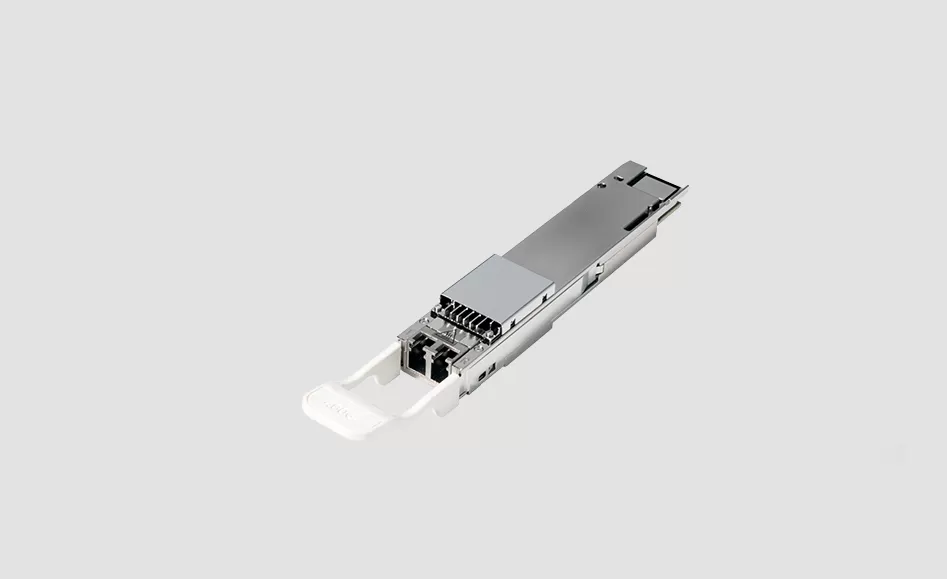
Fronthaul connects the baseband unit to the radio unit, and in an open radio access network it carries the split traffic between them, commonly 25G eCPRI over one or two fibres. The link has to move that traffic and pass timing, because the radio units and baseband units have to agree on time to a much finer resolution than the data path needs.
Both budgets run over the same fibre and the same optics, so fronthaul selection is not only a distance question: the module has to sit inside a latency and asymmetry budget the timing chain can absorb, and keep doing that at an outdoor temperature. The column behind this page is optics for 5G backhaul, the rate families are on 25G SFP28 and 10G, and the timing side is on telecom synchronisation products.
Distance sets the first constraint: radios on a mast or pole sit within a few hundred metres of a hub in a dense area and up to ten kilometres away in a rural one, so the same network mixes short and long runs under the same management.
Timing sets the second. Frequency synchronisation and time of day are transported over the packet network, and the radio needs both to hold the air interface. Where the timing chain runs across the optical link, the link has to be transparent to it: no re-timing that discards the marker, no asymmetric delay that shifts the time estimate, no link flap that resets the chain and takes minutes to re-converge.
| Module | Rate | Media / wavelength | Reach class | Where it usually lands |
|---|---|---|---|---|
| 10G SFP+ grey | 10G | SMF or MMF, 1310 / 1550 nm | 300 m to 10 km class | Legacy fronthaul and management links |
| 25G SFP28 grey | 25G | SMF or MMF, 850 / 1310 nm | 100 m to 10 km class | Standard single link fronthaul and mid-haul |
| 25G SFP28 industrial temperature | 25G | SMF, 1310 nm | 10 km class | Radio units in outdoor cabinets and on poles |
| 25G BiDi single fibre | 25G | SMF, single fibre pair of wavelengths | 10 km class | Where only one strand reaches the site |
| 25G and 50G CWDM or DWDM | 25G / 50G | SMF, coarse or dense grid | 10 to 40 km class | Several radio sites sharing one fibre pair |
| 50G SFP56 | 50G | SMF or MMF | 100 m to 10 km class | Higher order sectors and mid-haul aggregation |
| Passive WDM and mux modules | Per channel | SMF, CWDM or DWDM | Site dependent | Feeding several radio units off one strand pair |
Reach classes are the standard ones for each family and the working limit is the measured loss on the route, including the passive layer where several radio units share a strand. The WDM options are compared on CWDM, DWDM and SWDM4 and the single fibre case on BiDi against duplex.
An optical module adds a small delay, and the number itself is rarely the problem: two modules of the same part number can differ slightly, and a timing chain that corrects for a fixed asymmetry quietly absorbs a variable one.
The practical rules are to buy one part type for a timing path rather than mixing types, to keep both directions on the same part type where the link is part of a time chain, and to avoid mid-path re-timing that strips the timing marker. Where a link carries time, the module delay and the measured asymmetry belong in the link record, so a replacement can be checked against the first unit fitted.
Outdoor radio units see a much wider range than a data centre, so the temperature grade is a per position decision, not a network-wide one. A module rated for a conditioned room will work on a mild day and fail in a sealed cabinet in summer, and the failure usually shows up as a link that drops at the hottest hour and recovers by evening.
The same applies to dust and airflow direction: a shuttered outdoor cabinet with no airflow heats up, and the module diagnostics are how a maintenance team sees it coming. Ask for the grade in writing per position and check the reported temperature after the first hot week rather than at commissioning.
A fronthaul estate is rarely one generation of radio: the same hub can serve 10G and 25G sectors, indoor and outdoor units and more than one radio vendor. Group positions that can share a part, hold one part type per group, and keep a coded spare per group rather than a percentage of the population.
Coding matters here as anywhere else: the part is programmed for the platform named on the request and tested on that model, and it is not manufactured by the brand of the host. A spare coded for the wrong hub sits in the store until it is re-coded, a delay the network cannot afford during a cell outage.
What rate does fronthaul need?
25G is the common working rate for one 5G sector set, with 10G still in service on older sectors and 50G appearing on the higher order ones. The right answer comes from the split and the number of sectors on the link.
Do I need industrial temperature parts?
For radio units in outdoor cabinets or on poles, yes; for a conditioned hub a standard grade is usually enough. It is a per position decision and belongs on the purchase line.
Can fronthaul and timing share one optical link?
Yes, and that is the usual arrangement. The requirement is transparency: the link must not re-time or drop the timing marker, and one module type along the path keeps the asymmetry figure repeatable.
Is a passive mux a problem for timing?
No. Passive mux modules add loss and delay but no re-timing, so they fit a timing path as long as the loss budget includes the mux.
What do you need to quote a fronthaul roll-out?
The site list with indoor or outdoor placement, the measured distances and loss, the strands available per site, the rates per sector, the timing requirement, and the quantity per part with spares as separate lines.
Send the site list with placement, distances, strand counts and the rates per sector, and we come back with a part per position, the reach class and the coded spare lines. Related reading: fronthaul optics for O-RAN 7.2, how SyncE works in 5G networks, and all optics selection guides.
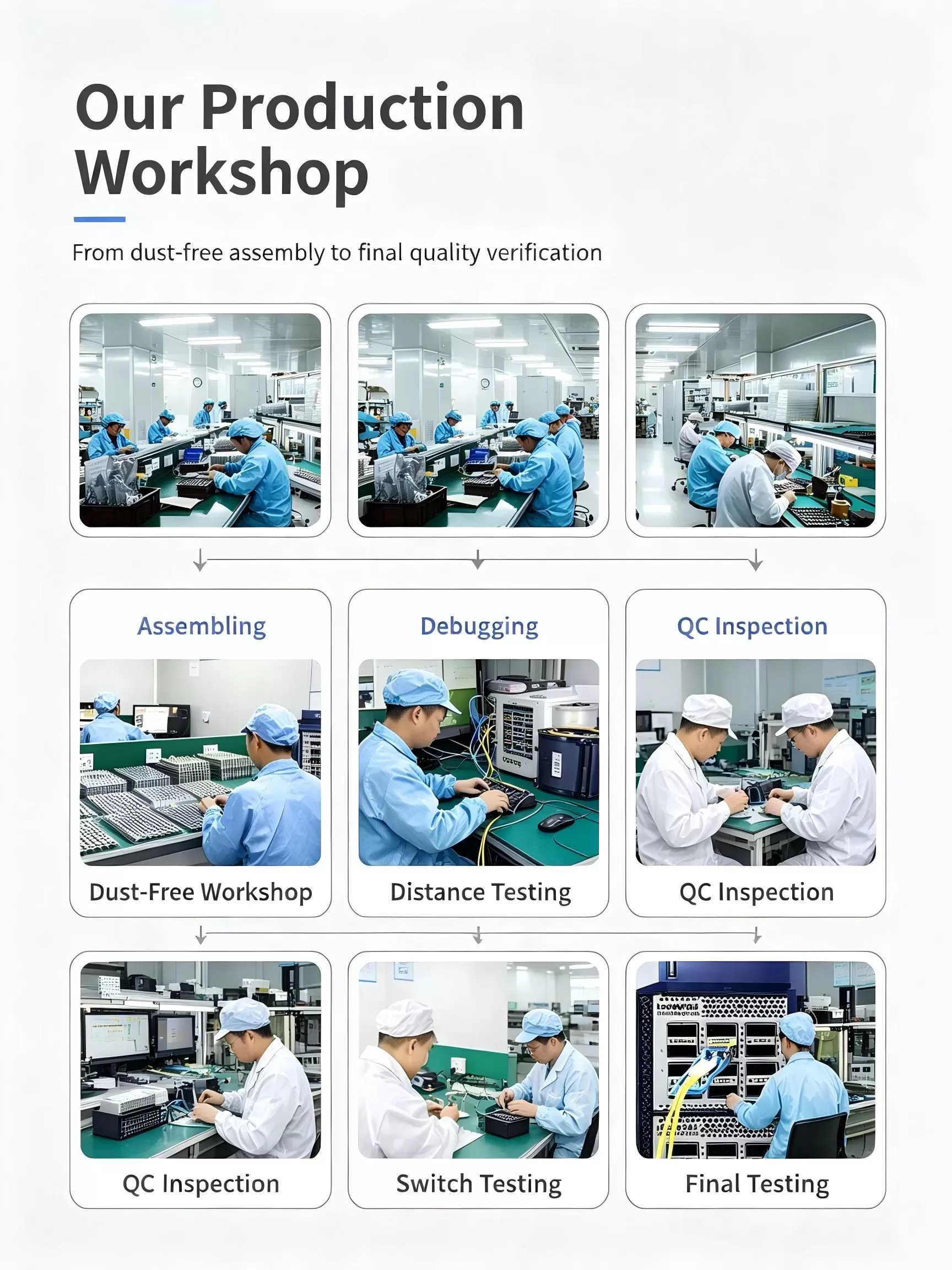
APEX is a communication technology brand focused on optical transceivers, telecom synchronization products, and network infrastructure equipment. We provide products and engineering support for telecom operators, data centers, mobile networks, and enterprise customers worldwide.
APEX GROUP is headquartered in Hong Kong, with our core team and supply chain operations based in China. We ship to customers across Asia, the Middle East, Europe, Africa, and the Americas.
We are a brand owner with deep engineering partnerships. We control product design, specification, quality validation, and supply chain management. Our products are built to our specifications by qualified manufacturing partners, and we handle all testing, coding, and quality assurance before shipment.
Yes. We code transceivers to match the host platform requirements of major switch and router vendors including Cisco, Juniper, Arista, HPE, Huawei, Nokia, and others. Tell us your platform model and required OS version, and we will ship modules that are recognized natively by your equipment.
Datasheets, compatibility matrices, and S-parameter reports are available for all standard products. Contact our sales team or visit the product pages on our website to request documentation.
Provide us with your switch make, model, and OS version. We code the transceiver firmware accordingly before shipment. If you are testing for the first time, we recommend ordering a sample unit to validate compatibility in your specific environment before placing a volume order.
Switch vendors occasionally introduce transceiver whitelisting in new OS releases. We track major platform updates and can provide recoded firmware matching the new OS requirements. Contact technical support if your existing APEX modules stop being recognized after a switch upgrade.
Contact our sales team by email, WhatsApp, or WeChat with your part number and quantity. We will confirm pricing, lead time, and shipping options. For first-time customers, we typically recommend starting with a sample order to validate compatibility before scaling to production volumes.
We ship via DHL, FedEx, and UPS for express delivery, typically 3-7 business days to most destinations. For volume orders, we also offer air freight and sea freight options. We can ship on your courier account or ours, and we handle all export documentation.
Sample orders start from 1-2 units for evaluation. For production orders, MOQ varies by product type, typically 10-50 units for standard transceivers. Contact us for specific product MOQs.
We accept wire transfer (T/T) as our standard payment method. For established customers, we can offer net-term payment arrangements. Contact our sales team to discuss payment terms.
All APEX products come with a 3-year standard warranty against manufacturing defects. We offer advance replacement for defective units, shipping the replacement before you return the failed unit to minimize downtime. For full details, visit our After-Sales Service page.
Contact us by email, WhatsApp, or WeChat. Describe your issue with as much detail as possible, including switch model, OS version, transceiver part number, and the problem you are seeing. Our support engineers will respond within one business day.
Yes, we strongly encourage sample testing. Order 1-2 units of each model you plan to deploy. Test them in your switches with your fiber plant and traffic load. Once validated, we can proceed with production quantities.
Yes. Many of our customers are telecom operators and government networks requiring 5-10 year supply continuity. We offer lifecycle management commitments with advance notification of any changes. See our Global Supply Chain page for details on long-term supply programs.

APEX GROUP LIMITED
Phone: 85298213834
WhatsApp: 85298213834
Email: Info@apexallinone.com


